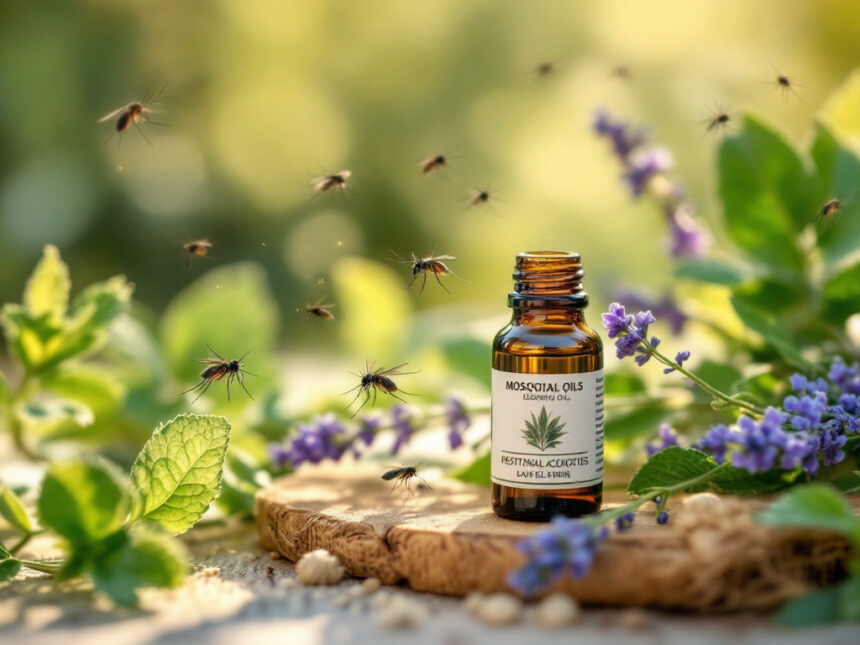
Natural ways to keep mosquitoes away can feel confusing. You hear that essential oils for mosquito repellent are “natural and safe,” but then you also see warnings about skin irritation and short protection times. This guide helps you sort through the noise so you can choose a few starter oils, use them wisely, and understand when a conventional repellent still matters.
You will find the top essential oils for mosquito repellent, how they actually work, simple DIY recipes, and safety tips if you have kids, pets, or sensitivities.
How essential oils repel mosquitoes
Mosquitoes use scent to find you, especially the smell of sweat, body odor, and the carbon dioxide you breathe out. Essential oils work by masking or interrupting those signals so mosquitoes have a harder time locating you.
Technical specialists explain that essential oils help by camouflaging your natural body scent, which reduces how attractive you are to female mosquitoes that are looking for a blood meal. When you apply a repellent blend to your skin or clothing, mosquitoes tend to avoid landing in that treated zone.
You also need to know that essential oils evaporate quickly from your skin. That is why they rarely give the all‑day protection you get from synthetic repellents. Studies show that lower concentrations like 5 or 10 percent do not prevent bites, and even higher levels of some oils only protect you for 1.5 to 3.5 hours before you need to reapply. High concentrations can also irritate your skin and may have strong odors that many people do not enjoy.

So essential oils can help reduce bites, especially for short, low risk time outdoors. They are not a complete replacement for an EPA registered repellent if you are in an area with serious mosquito borne diseases.
Oil of lemon eucalyptus (PMD)
Oil of lemon eucalyptus is one of the few plant derived ingredients that public health agencies treat similarly to conventional repellents.
The distilled essential oil of lemon eucalyptus contains para menthane 3,8 diol, or PMD. The Centers for Disease Control and Prevention recommends repellents with oil of lemon eucalyptus because PMD is the only plant based active ingredient endorsed by the CDC for use in regions where mosquitoes transmit diseases like malaria. The Environmental Protection Agency classifies PMD as a biopesticide and approves it in registered insect repellent products.

Concentration really matters. Research shows that repellents under 10 percent active ingredient usually protect you for only one to two hours, and that water, sweat, and rubbing reduce the effect quickly. Higher strength PMD formulations extend that window, although you still need to reapply according to the label.
You should also be aware of safety notes. Animal studies report that oil of lemon eucalyptus can cause eye damage and skin irritation, so you want to avoid the eye area and wash out any accidental contact right away. WebMD and public health sources advise against using lemon eucalyptus oil on children under 3 years old because of these risks. For pregnant and breastfeeding women, the CDC includes oil of lemon eucalyptus, along with DEET, picaridin, and IR3535, as an option when used exactly as directed.
If you want a “natural leaning” repellent with more robust science behind it, you are usually better choosing an EPA registered PMD product instead of trying to blend raw lemon eucalyptus essential oil at home.
Citronella essential oil
Citronella oil is one of the most familiar essential oils for mosquito repellent. It comes from Cymbopogon species like Cymbopogon nardus, and is rich in citronellal and geraniol. You see it in candles, sprays, and outdoor torches because many people associate its scent with bug free evenings.
Research on citronella is mixed. WebMD notes that scientists still do not have enough reliable information to definitively confirm how effective it is on its own for preventing mosquito bites, although it is widely used and studied. A 2015 field study in Nepal evaluated citronella oil from Cymbopogon winteratus to explore its potential to prevent mosquito borne diseases, which shows ongoing interest, not a final verdict.
Some reviews suggest that products with adequate citronella levels, especially when combined with other essential oils, may approach the performance of lower strength DEET for short periods. The U.S. Food and Drug Administration even includes insect repellent products with citronella oil in its regulatory docket for over the counter sunscreen and insect repellent combinations.

The biggest issue for you is durability. Citronella evaporates fast. You may get 30 minutes or a bit longer before the scent fades and the protection drops off, especially if you are sweating or moving around. You also still need to follow safety guidance from public health agencies, which recommend proper dilution, patch testing, and avoiding use on very young children.
In practice, citronella works best as one piece of your strategy. You can layer it in a spray along with other oils that have stronger data behind them, and you can use it in candles or diffusers as an extra deterrent around your seating area.
Clove essential oil
If you are looking for one of the harder working essential oils for mosquito repellent, clove oil deserves your attention, although it is also one of the most intense.
A 2023 study in Scientific Reports tested 20 essential oils from the Environmental Protection Agency minimum risk pesticides list using a 10 percent lotion emulsion against Aedes aegypti mosquitoes. Clove oil and cinnamon oil delivered the longest complete protection times, more than one hour without bites in a controlled arm in cage test. The same 10 percent clove oil lotion also helped repel blacklegged ticks, which suggests broader activity.
Earlier laboratory tests that explored a range of concentrations from 5 to 100 percent found that clove and thyme oils provided 1.5 to 3.5 hours of protection at higher levels, although nothing at 5 or 10 percent stopped bites entirely. The catch for you is usability. At concentrations of 25 percent and above, participants judged clove oil’s odor unpleasant and reported that it could irritate their skin.
This puts clove in the “occasional, well diluted” category. You might include a small amount in a blend to boost performance for a short hike or an evening on the porch, but you probably will not want a strong clove forward repellent for daily use, especially on children or sensitive skin.
If you decide to try clove, you will want to learn how to dilute essential oils correctly so you stay below the levels that most people find irritating.
Cinnamon essential oil
Cinnamon oil performed alongside clove oil at the top of the pack in the 2023 Scientific Reports study. At 10 percent in a lotion base, it provided complete protection for more than one hour against Aedes aegypti and also helped repel ticks in contact tests.
The same analysis found that leading oils like clove, cinnamon, and geraniol shared complex terpene profiles, including compounds such as caryophyllene (E), longifolene, and myrtanol acetate. These overlapping components may contribute to their mosquito and tick repellency, although researchers are still mapping out the exact mechanisms.
You face similar tradeoffs with cinnamon as with clove. Its scent is strong, and high concentrations that deliver longer protection can irritate your skin. Cinnamon bark oil is especially potent, so many practitioners prefer cinnamon leaf oil in topical formulas because it is somewhat gentler.
You can use a small percentage of cinnamon oil in a broader blend that also includes softer oils like lavender. This lets you benefit from its repellent properties while minimizing the risk of stinging or redness.
Geranium and geraniol rich oils
Geranium oil, particularly Bourbon geranium, is another essential oil that appears frequently in mosquito formulas. Its star component is geraniol, which provides short term repellent effects.
WebMD notes that geraniol can help keep mosquitoes away, but the duration of protection is limited compared to longer lasting ingredients. In the 2023 Scientific Reports work, 10 percent geraniol lotion produced more than an hour of protection against both mosquitoes and ticks, placing it in the top tier with clove and cinnamon.
An earlier lab study that mixed essential oils at different concentrations also found that a 50 percent clove oil combined with 50 percent geranium or thyme oil prevented biting by Anopheles albimanus mosquitoes for up to 2.5 hours. The problem was that these very high concentrations were judged unacceptable in odor and could irritate the skin, which limits how practical they are for you.
In real life, you can include geranium oil at moderate levels in a blend for a pleasant floral note and modest repellent help. Because geraniol can also show up in some essential oils for skin care, you may find that a body oil or lotion you already enjoy doubles as a light deterrent when you add a bit of geranium.
Peppermint essential oil
Peppermint oil contains menthol, which creates a cooling sensation on your skin and can repel mosquitoes. WebMD mentions peppermint as one of the natural options for mosquito deterrence. Many people like the fresh scent, and you may already use peppermint in blends for essential oils for headaches or essential oils for nausea.
The research is more cautious. In one laboratory study, only high concentrations of peppermint oil were effective at repelling Aedes aegypti, and even then protection times were limited. Lower concentrations of 5 or 10 percent did not prevent bites in tested conditions, which suggests that a lightly scented spray is not enough on its own.
On the positive side, the 2023 Scientific Reports research found that 10 percent peppermint lotion still delivered more than 30 minutes of protection in arm in cage tests, which is not as strong as clove or cinnamon but is still a meaningful reduction in bites.
You can think of peppermint as a “supporting actor.” It is great in a blend for a cooling feel and a scent mosquitoes tend to dislike. You just should not rely on peppermint alone for longer outings, and you need to dilute it carefully because menthol can be irritating for children and anyone with sensitive or compromised skin.
Thyme essential oil
Thyme oil is less famous than citronella or peppermint, but studies point to it as one of the more effective essential oils for mosquito repellent at higher concentrations.
Laboratory tests that compared Bourbon geranium, cedarwood, clove, peppermint, and thyme found that thyme and clove delivered the best protection, around 1.5 to 3.5 hours depending on the concentration. As with clove, low concentrations below 10 percent did not prevent biting, so you need a more robust dose for meaningful results.
The same research reported that concentrations of 25 percent and above had strong odors and could irritate the skin, which makes them hard for most people to tolerate. That is important if your household is “safety first” and you want gentle, kid friendly products.
If you enjoy the herbal scent of thyme, you can include a small amount in a blend, possibly alongside lavender or geranium. This can give you some extra repellent power without pushing the concentration high enough to cause burning or redness.
Lavender, basil, and eucalyptus
Some essential oils have gentler reputations and are often used for essential oils for relaxation or best essential oils for sleep. You might be wondering if they can help with mosquitoes too.
A 2022 mosquito control article notes that scents like lavender, peppermint, basil, and eucalyptus can repel mosquitoes by overwhelming and disorienting their senses. These oils help camouflage your body odor, and they often smell more pleasant than clove or thyme.
In the 2023 Scientific Reports assay, 10 percent emulsions with peppermint, geranium, lemongrass, garlic, spearmint, or citronella oils also provided more than 30 minutes of protection, though less than an hour. That suggests that many aromatic oils deliver short bursts of help, even if they are not as strong as the top performers.
For you, that means a lavender and eucalyptus blend can be a good choice for low risk situations, like reading on your patio for half an hour or walking the dog at dusk in a well maintained neighborhood. You just need to accept that you will reapply often and that these blends cannot substitute for a registered repellent in high risk areas.
Because lavender and eucalyptus cross over into other categories, such as essential oils for aromatherapy and essential oils diffuser blends, they can also support better sleep and calmer moods while they help with bugs a bit.
How to blend and use mosquito repellent oils
The biggest challenge with essential oils for mosquito repellent is staying safe while using a high enough concentration to actually make a difference. You also have to respect that each person’s body chemistry is different, so you might need a little trial and error to find a mix that works for you.
Shannon Harlow Ellis, a technical specialist for Mosquito Joe, shares simple DIY recipes based on common kitchen ingredients. For example, you can mix one third cup coconut oil with 15 drops of peppermint essential oil for a solid balm style repellent. You can also combine a quarter cup apple cider vinegar, a quarter cup water, and 40 drops of rosemary oil in a spray bottle, or blend equal parts witch hazel and water with 40 drops of eucalyptus oil for a strong smelling spray mosquitoes dislike.
These recipes rely on the persistence of the scent. As another expert points out, once the fragrance fades, so does the repellent effect. That means you have to reapply frequently if you want to maintain protection, especially in hot or humid conditions.
Before you experiment, it is smart to understand the basics of how to use essential oils and how to dilute essential oils. You will want to:
- Keep total essential oil concentrations for general body use relatively low, usually under 10 percent, unless you are working with a practitioner.
- Avoid applying essential oils undiluted to children, your face, or any broken or irritated skin.
- Patch test new blends on a small area of your inner arm at least 24 hours before broader use.
- Keep blends away from eyes and mucous membranes, especially with strong oils like lemon eucalyptus, clove, and cinnamon.
If you get bitten despite your best efforts, you can turn to essential oils for insect bites for soothing aftercare. Lavender, chamomile, and tea tree are often used to calm itching and support natural skin healing when diluted properly.
When to choose conventional repellents instead
Natural repellent blends have a place in your toolkit, especially if you prefer plant based approaches and understand their limits. However, there are situations where you should reach for an EPA registered product first.
The CDC recommends insect repellents containing DEET, picaridin, IR3535, or oil of lemon eucalyptus for pregnant and breastfeeding women in areas where mosquito borne diseases are a concern. These active ingredients have been studied more extensively for both efficacy and safety, and labels provide clear directions for how often to reapply.
Essential oils like garlic, rosemary, lemongrass, thyme, or geraniol are not present in any EPA registered repellents, and their health risks and effectiveness have not been as widely verified as the common synthetic repellents. That does not mean they never help, but it does mean you should be cautious about using them as your only line of defense in high risk environments.
If you live or travel in regions where malaria, dengue, Zika, or West Nile virus are active, you will usually be safer following public health guidance and choosing a registered product, then perhaps layering in essential oils as a supplementary measure around your home or clothing.
Choosing quality oils and building a simple starter kit
If you are new to essential oils, it is easy to feel overwhelmed by brand claims and buzzwords. The same general rules that apply to therapeutic grade essential oils and everyday essential oils benefits also apply to repellent blends.
Try to choose oils that are:
- Pure and unadulterated, with no added synthetic fragrances.
- Clearly labeled with the Latin botanical name and plant part used.
- Stored in dark glass bottles and kept away from heat and light.
For a simple mosquito focused starter kit that can double for other uses, you might choose:
- Lemon eucalyptus or a PMD based repellent product, for more serious outdoor time.
- Lavender, for gentle support, sleep, and after bite care.
- Peppermint or eucalyptus, for short term repellence, cooling, and breathing support.
- An additional “power oil” like clove, cinnamon leaf, or geranium, to include in small amounts when you need extra help.
These same oils can also find a home in essential oils recipes for essential oils for cleaning, essential oils for laundry, or essential oils for massage, so you get more value from your collection beyond mosquito season.
Key takeaways
- Essential oils for mosquito repellent work mainly by masking and confusing the scents that attract mosquitoes to you.
- Oil of lemon eucalyptus, specifically its PMD component, is the only plant based active ingredient endorsed by the CDC, and it appears in EPA registered repellents.
- Clove, cinnamon, and geraniol rich oils show some of the strongest lab results, but often need higher concentrations that can irritate your skin and carry strong odors.
- Citronella, peppermint, lavender, basil, eucalyptus, and rosemary provide shorter protection windows and work best in blends for low risk situations, with frequent reapplication.
- Safety comes first. Proper dilution, patch testing, age appropriate use, and following public health advice are essential, especially if you are pregnant, breastfeeding, or caring for children.
- In areas with mosquito borne diseases, you are usually better off relying on EPA registered repellents, using essential oils as a complement instead of your only shield.
If you start with just one step, choose a single blend to test on a quiet evening outdoors, then adjust the ingredients or concentration based on how your skin feels and how the mosquitoes behave. Over a few tries, you will find a routine that fits your comfort level, your family’s needs, and your favorite summer activities.
FAQs
Do essential oils for mosquito repellent really work?
Yes, some can reduce bites, but protection is usually shorter than standard repellents because oils evaporate quickly. Expect frequent reapplication.
What is the best essential oil for mosquito repellent with real evidence?
Oil of lemon eucalyptus (OLE) / PMD is the most evidence-backed plant-derived option and is listed by CDC among recommended active ingredients in EPA-registered repellents.
Is oil of lemon eucalyptus safe for children?
CDC advises not using OLE/PMD products on children under 3 years old.
How should I apply repellent safely to the face?
Don’t spray directly on the face. Spray on hands first, then apply carefully, avoiding eyes and mouth.
Do citronella candles keep mosquitoes away?
They can help around a small area, but they’re best as a supporting layer. For skin protection, follow EPA/CDC guidance on proven actives.
Are essential oils safe around pets?
Not always. Some oils (like peppermint, cinnamon, clove, eucalyptus, tea tree) can be risky — especially for cats — so use extra caution with diffusers and topical exposure.