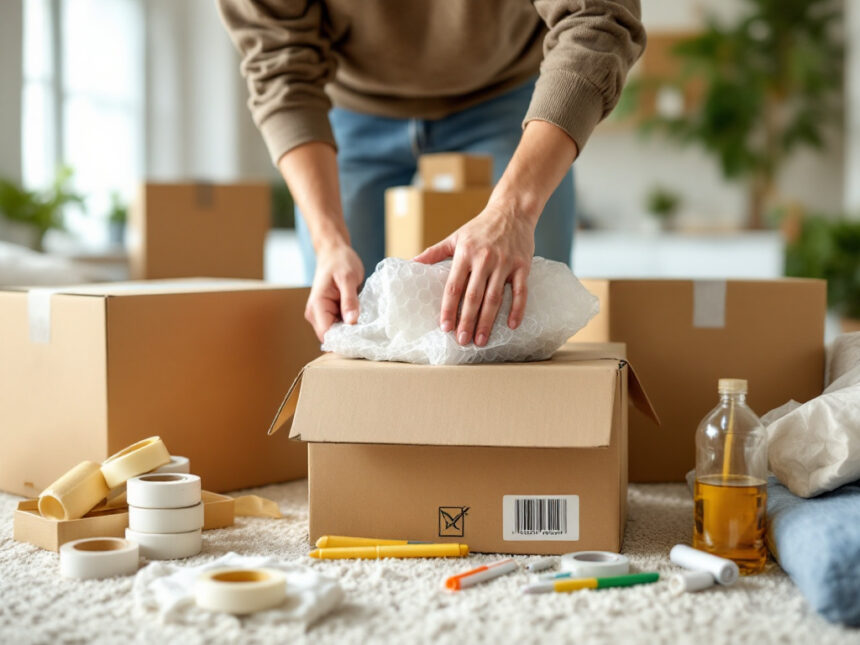
A well packed box is the difference between a smooth move and a stressful one. When you learn how to pack moving boxes the right way, you protect your stuff, make loading easier, and save yourself time on the other end when it is time to unpack.
The guide below walks you through the entire process, step by step, whether you are moving out of a studio apartment, a busy family home, or you are mostly worried about fragile dishes and heavy books.
Get organized before you start packing
Packing actually starts before you touch a single box. A little prep work makes every box faster and safer to pack.
Declutter room by room
Every item you choose not to move saves you wrapping, taping, loading, and unpacking time.
Before you reach for the tape, walk through your home with three categories in mind: keep, donate/sell, and trash. Professional organizers suggest looking at broad categories like clothing, books, papers, and sentimental items first so you can see how much you really own and make intentional choices about what deserves a spot in your new space.

If you are moving from a small apartment, be ruthless with duplicate kitchen gadgets, extra linens, and old décor. For family homes, involve older kids in sorting toys and clothes so you do not spend time packing things they have outgrown.
Make a simple packing plan
You do not need a complicated spreadsheet, but you do need a game plan.
Decide:

- Which rooms you will pack first and last
- What you will need during the final days in your current place
- What must be accessible on the first night in your new home
Pros recommend breaking rooms into smaller sections so the work feels manageable and less overwhelming. For example, you might do “hall closet” one evening and “upper kitchen cabinets” the next.
Set aside a staging area where you keep all your boxes and supplies together so you are not constantly hunting for tape or markers.
Create an essentials bag and “open first” boxes
Some items should never disappear into the depths of a truck.
Pack a personal essentials or overnight bag with:
- Toiletries and medications
- A change of clothes for each person
- Phone and laptop chargers
- Important documents and valuables
- Basic tools like a box cutter, screwdriver, and tape measure
Many movers on Reddit swear by this approach, so they are not digging through random boxes for a toothbrush or phone charger on the first night in a new place.
Next, pack clearly labeled “Open First” boxes for each main room, especially the kitchen and bedrooms. Include things like basic cookware, a few plates and cups, sheets, and a shower curtain. Experts suggest transporting these by car instead of putting them on the truck, so they are guaranteed to arrive and be easy to grab on day one.
Choose the right moving boxes and supplies
The right materials make packing faster and your boxes much safer to stack and move.
Match box sizes to what you are packing
When you are figuring out how to pack moving boxes efficiently, size matters.
In general:
- Use small moving boxes for heavy items like books, canned food, tools, and small appliances.
- Use medium moving boxes for mixed loads like pantry items, office supplies, and bathroom products.
- Use large moving boxes and extra large moving boxes for light, bulky items such as bedding, pillows, and lampshades.
Professional packers strongly recommend using more small and medium boxes and reserving the largest boxes for very light items so the weight stays manageable.
If you are moving a lot of books, look for dedicated moving boxes for books that are compact and sturdy so they do not bow or burst.
Uniform, new cardboard moving boxes are easier to stack and less likely to collapse. Moving companies note that new boxes are stronger and more predictable than old grocery boxes or a random mix of leftovers (Allied Van Lines).
If you are looking to save money without sacrificing durability, a moving boxes kit bundles a mix of sizes, tape, and often packing materials so you are stocked from the start.
Pick durable boxes for fragile or heavy items
Fragile and heavy items put more stress on your boxes, so they need extra support.
Look for heavy duty moving boxes for:
- Dishes and glassware
- Small kitchen appliances
- Collections of books or records
- Electronics and gaming consoles
Experts recommend small or medium heavy duty boxes with double cardboard walls for fragile items, and they advise reinforcing the bottom with a double layer of tape down the center and along both side seams to prevent collapse under weight.
If you already know you have lots of delicate items, moving boxes for glasses and moving boxes for dishes with built in dividers can minimize breakage and speed up packing.
Gather the right padding and tools
Good packing materials absorb shocks and keep items from shifting.
Professional movers recommend a mix of:
- Packing paper or newsprint for wrapping dishes and ceramics
- Bubble wrap for cushioning fragile items like glass, collectibles, and electronics
- Foam sheets for flat items such as plates and framed photos
- Moving blankets or thick towels for furniture and large electronics
- Packing peanuts or crumpled paper to fill gaps and prevent movement
Pros often prefer crush paper over bubble wrap for many items because it molds easily and fills empty spaces while still offering good protection.
You will also want:
- High quality packing tape, not thin bargain tape that peels up
- A tape dispenser or gun
- Permanent markers for labeling
- Utility knife or scissors
If you are buying everything at once, check moving boxes for sale or moving boxes bulk to keep your per box cost low, especially for larger family moves.
Pack room by room instead of all at once
Packing randomly makes your new home harder to set up. A room by room approach keeps you organized and makes it much easier to find things later.
Focus on one area at a time
Choose a room, set up a small packing station with your boxes and supplies, and work from least used items to daily essentials.
For example, in your kitchen you might:
- Pack rarely used serving platters and holiday dishes first.
- Move on to small appliances you can live without for a week.
- Leave everyday dishes and cookware for last.
This approach mirrors what professional organizers recommend, which is to break rooms into sections and work methodically instead of bouncing between spaces.
If you live in a walk up or have tight stairs, think about the path the boxes will take. Keep the heaviest boxes closest to the door or elevator so they are easier for you or movers to grab and go.
Color code boxes by room
One of the easiest ways to speed up your move is to label by room using a color system.
Kathryn Kelly, a professional organizer trained by Marie Kondo, suggests assigning each room in your new home a color, then placing colored duct tape or stickers on the corresponding boxes. This simple color coding saves time during unloading and helps friends or movers know instantly where each box should go.
You can combine colors with room names written on the top and at least one side, so labels are visible even when boxes are stacked.
Use a safe and sturdy packing method
Whether you are packing books, dishes, clothes, or décor, the same core technique makes boxes stable and stackable.
Build a strong base every time
Start by assembling your box and taping the bottom from edge to edge. For heavier or fragile items, run a second strip of tape down the center seam and add short pieces across the side seams.
Pros suggest a “double tape” method on heavy duty boxes so seams do not split when you lift them.
Before you add items, put a layer of crumpled paper or foam on the bottom of the box. This acts like a shock absorber if the box gets bumped or stacked under something else.
Pack in layers from heavy to light
Think of each box as a sandwich. Heavier pieces go on the bottom, cushioning in the middle, and lighter items on top.
A basic formula that works for most boxes looks like this:
- Bottom: Heavier items, placed flat or upright and snug together.
- Middle: A layer of crumpled paper or foam sheets.
- Top: Lightweight, less fragile items that can handle a bit more movement.
Professional organizers emphasize filling boxes in layers and then topping off any empty spaces so the box stays rigid and less likely to collapse.
Do not overpack or underpack
Overstuffed boxes are hard to carry and more likely to break. Underfilled boxes crush easily when stacked.
Moving companies recommend keeping each box under about 50 pounds and doing a quick lift test before sealing. If it feels wobbly or too heavy, redistribute items into another box.
At the same time, avoid half full boxes. Reddit users point out that half empty boxes invite items to shift and get damaged, especially when stacked with other boxes. If there is extra room, fill gaps with towels, linens, or crumpled paper so everything stays in place.
Pack fragile items so they survive the move
Fragile items need more time and attention, but the right technique dramatically reduces breakage.
Wrap each fragile item individually
For dishes, glassware, and ceramics, wrap each piece separately. Use packing paper for most items and bubble wrap for especially delicate or valuable pieces.
Experts advise:
- Using foam sheets or paper for flat items like plates and framed pictures
- Using bubble wrap and extra cushioning for glass, collectibles, and electronics
- Adding corrugated inserts or cardboard separators between thin or delicate panels when possible
When in doubt, wrap one more layer. It costs less to use extra paper than to replace broken glassware.
Use the right boxes and orientation for dishes
Dishes are heavier than they look, so they need sturdy, compact boxes.
Pros suggest packing dishes in small or medium heavy duty boxes with double walled cardboard, then reinforcing the bottom with several layers of tape. If you prefer a ready made solution, look for moving boxes for dishes that include dividers.
A helpful trick is to pack plates on their ends instead of stacking them flat. Wrap each plate, place tight rolls of crumpled paper (often called “sausage rolls”) along the bottom and sides of the box, and then slot the plates in upright. Add more rolls on top before you close the box to prevent shifting.
This vertical method reduces pressure points, so plates are less likely to crack.
Protect glasses and stemware from pressure
Glasses and stemware benefit from boxes with compartments or cardboard separators. If you do not have specialty moving boxes for glasses, you can create simple dividers with folded cardboard.
Wrap each glass inside and out with paper or bubble wrap for very delicate pieces. Leave about an inch of space between items and avoid stacking glassware directly on top of each other to prevent collisions under pressure.
Fill all remaining space with paper or foam so glasses do not rattle when you gently shake the box.
Safely pack artwork, mirrors, and TVs
Flat, breakable items like artwork and mirrors need special attention. Long, narrow boxes are ideal for these pieces, and there are dedicated moving boxes for artwork that are sized for frames and canvases.
Experts recommend:
- Wrapping each item in moving blankets or bubble wrap
- Using long, sturdy boxes so the item can stand upright
- Adding cushioning to the bottom and sides of the box so edges do not bear all the weight
For TVs, use the original box if you still have it. If not, a heavy duty, appropriately sized box with plenty of padding and foam inserts will protect the screen.
Fill every gap and label clearly
Once your fragile box is packed, fill all remaining spaces with foam sheets, crumpled paper, towels, or clothing to prevent any movement. The goal is for items to feel locked in place.
Seal the box with tape and label it “Fragile” on several sides, along with arrows indicating which side should stay up. Movers and helpers are much more cautious when they can see which boxes need extra care.
Pack heavy items like books and appliances
If you are moving a lot of books or small appliances, smart packing will protect your back and your boxes.
Keep book boxes small and dense
Books are deceptively heavy. Reddit users warn that more than about a cubic foot of books can quickly turn a box into something that is almost impossible to lift safely.
Use compact moving boxes for books or small moving boxes. Pack books flat or standing upright, tighten them against each other, and then use small towels or paper to fill the leftover space at the top so they do not shift.
If you have to tuck books into a slightly larger box, limit them to the bottom third and fill the rest of the space with lightweight items like throw pillows or linens.
Prepare and pack small appliances
Before packing small appliances, make sure they are clean and dry. Remove loose or detachable parts like blades, trays, or glass containers.
Wrap each component separately in paper or bubble wrap, then place the main unit upright in a medium moving box or heavy duty box. Surround it with crumpled paper, foam, or towels. Try to recreate the snug fit of the original packaging and avoid leaving open space where parts can shift.
For very dense appliances like stand mixers, choose a smaller heavy duty box and do a lift test before sealing.
Pack clothes, linens, and soft items efficiently
These items might not be fragile, but packing them thoughtfully saves space and keeps your new closets organized.
Use the right boxes for clothing
You have several options for clothing, depending on how much you have and how you want to unpack.
- Everyday folded clothes can go into medium packing boxes for moving or suitcase type luggage.
- Hanging clothes can go into wardrobe style moving boxes for clothes so they stay on hangers and go straight into your new closet.
- Out of season or rarely worn items can be vacuum sealed to save space.
Fill gaps in clothing boxes with soft items like scarves or socks to keep everything compact.
Put bedding and linens to work as padding
Bulky but lightweight items like comforters, pillows, and towels are perfect for large moving boxes or extra large moving boxes. You can compress them slightly with bags, but you can also use them as built-in cushioning for other items.
For example, you can:
- Wrap lampshades in pillowcases
- Surround a boxed small appliance with towels inside a larger box
- Place folded blankets between layers of lightweight items
This approach reduces how much you spend on additional packing materials, and it keeps your soft goods clean in transit.
Label and track your boxes like a pro
Even the best packed boxes are frustrating if you do not know what is in them. A simple labeling and inventory system saves you hours of searching later.
Write clear and specific labels
At a minimum, each box should list:
- Destination room in the new home
- Short description of contents
- Special notes like “Fragile,” “Heavy,” or “Open First”
Experts suggest labels like “Kitchen, pots and pans” or “Bedroom, bedding” rather than vague ones like “misc” so you and your helpers know where to put everything.
Write on at least two sides and the top so the label is readable even when boxes are stacked, a tip many apartment movers on Reddit find especially helpful for tight hallways or storage units.
Consider box numbers and a simple inventory
For larger moves, especially family homes, assign each box a number. Then keep a basic inventory, either on paper or in a note on your phone.
Your inventory does not need to list every single item. A simple summary like “Box 14: Kitchen, baking supplies, mixer attachments” is often enough. The Spruce recommends using this kind of master inventory to track boxes during the move and to note high value or electronic items, including serial numbers and photos in case you ever need to file a claim.
This step takes a few extra seconds per box, but it pays off when you can instantly find your baking sheet or your child’s favorite stuffed animal.
Time your packing so you are not rushed
Rushing is one of the top reasons boxes end up overstuffed, under padded, or poorly labeled.
Start packing earlier than you think
Professional movers suggest starting the packing process at least two weeks before your move, and ideally a month in advance if you have a larger home. Begin with items you do not use daily, then work steadily toward your essentials.
A simple timeline might look like this:
- 4 weeks out: Declutter and pack storage areas, out of season items, and décor.
- 3 weeks out: Pack books, most linens, and less used kitchen tools.
- 2 weeks out: Pack office supplies, extra bathroom items, and the guest room.
- Final week: Pack everyday kitchenware, clothes, and kids’ items, leaving out just enough for the last few days.
Aim to have everything non essential packed at least a couple of days before the move. That buffer keeps you calm and gives you time for last minute cleaning.
Protect your back on moving day
Good packing protects your belongings, but it should also protect your body.
To keep boxes safe to lift:
- Follow the 50 pound guideline for maximum box weight
- Distribute heavy items across multiple small boxes rather than one oversized box
- Use dollies or hand trucks for stacks of boxes, especially in apartment buildings with long hallways or elevators
Label particularly heavy boxes as “Heavy” so helpers know to bend their knees and lift carefully.
Know where to get the best moving boxes
If you are starting from scratch, you might be wondering where to get affordable, sturdy boxes in the right sizes.
For new, uniform options that stack well, check:
- Moving boxes near me to find local retailers
- Where to buy moving boxes for a breakdown of in store and online options
- Moving box suppliers if you want high quality or specialty boxes
If you are trying to save money, you can mix in some used moving boxes along with new ones, as long as they are still sturdy and dry.
You can also stretch your budget by looking for free moving boxes and free boxes for moving, or checking guides on where to find free moving boxes. This can be especially helpful for lighter items, while you reserve new heavy duty boxes for fragile and dense belongings.
If you prefer an all in one solution, explore best moving boxes and moving box sizes so you can order a curated set that fits your space and belongings. Pay attention to standard moving box sizes and moving box dimensions so you do not accidentally order boxes that are too big for your elevator or too small for your larger items.
Quick tip: Mix and match. Use a core set of new heavy duty boxes for fragile and heavy items, then layer in gently used or free boxes for light, bulky belongings to keep your moving boxes cost under control.
Put it all together on moving day
Once your boxes are packed, labeled, and stacked, loading will feel much simpler.
Group boxes by room near the exit so movers or friends can grab all the “Kitchen” boxes at once. Place heavy, sturdy boxes on the bottom of stacks and lighter, fragile boxes on top.
If you packed methodically, your new place will be easier to set up too. “Open First” boxes and clearly labeled essentials will help you settle in quickly, even if you are tired from a long day of moving.
By taking the time to learn how to pack moving boxes properly, you are not just protecting your belongings. You are also giving yourself a calmer, more organized transition into your new home.
FAQs
What is the best way to pack moving boxes for a long-distance move?
For long-distance moves, durability and organization matter even more. Use new, heavy-duty double-walled boxes for fragile and heavy items. Wrap everything individually, fill all gaps with packing paper or foam, and seal every box with high-quality packing tape. Label boxes clearly on multiple sides with room names and contents, and consider creating a numbered inventory list so you can track every box across the journey.
How do I pack dishes and plates without them breaking?
Pack plates vertically — standing on their edges like records — rather than stacking them flat. Wrap each plate individually in packing paper or foam sheets, line the bottom of the box with crumpled paper “sausage rolls,” slot plates in upright, and top off with more padding. Use small or medium heavy-duty boxes with reinforced bottoms and label them “Fragile – This Side Up.”
How heavy should a moving box be?
Most professional movers recommend keeping boxes under 50 pounds. Heavy items like books, tools, and canned goods should always go into small boxes so the total weight stays manageable. Always do a quick lift test before sealing — if it feels too heavy to carry safely with both hands, redistribute the contents.
What’s the difference between small, medium, and large moving boxes?
Small boxes (1.5 cu ft) are ideal for heavy, dense items like books and canned goods. Medium boxes (3 cu ft) work well for mixed loads like kitchen items and office supplies. Large boxes (4.5+ cu ft) should be reserved for light, bulky items only — think pillows, comforters, and lampshades. Overloading large boxes is one of the most common packing mistakes.
Should I use new or used moving boxes?
New boxes are stronger, more predictable, and stack more uniformly — making them the best choice for fragile and heavy items. Used or free boxes can be safely used for lighter, non-breakable items like clothing, linens, and toys, as long as they are dry, undamaged, and still structurally solid. A smart strategy is to mix both.
When should I start packing for a move?
Start at least 2–4 weeks before your move date. Begin with storage areas, out-of-season items, and décor, then work your way toward everyday essentials. Leave daily-use items like kitchenware, toiletries, and clothing for the final week. Starting early eliminates the frantic last-minute rush that leads to poorly packed, overstuffed boxes.
How do I pack glasses and stemware so they don’t break?
Use boxes with built-in dividers or create cardboard separators yourself. Wrap each glass individually inside and out with packing paper or bubble wrap. Leave about an inch of space between items, avoid stacking glasses directly on top of each other, and fill all remaining gaps with foam or crumpled paper so nothing rattles. Label the box “Fragile – Glassware – This Side Up.”
Can I use towels and linens as packing material?
Absolutely — and it’s one of the smartest moves you can make. Towels, blankets, pillowcases, and clothing are excellent padding for fragile or delicate items. Wrap lampshades in pillowcases, cushion appliances with folded towels, and layer blankets between breakable items. This reduces packing supply costs and puts your soft goods to work during the move.