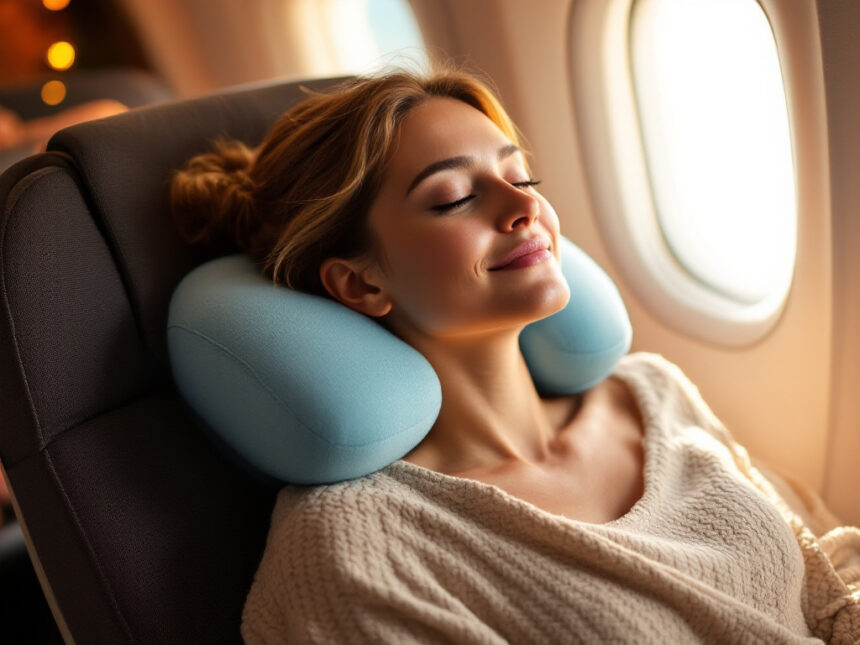
A regular neck pillow is usually designed for people who sleep upright or lean straight back. If you are a side sleeper, your neck needs a different kind of support to stay aligned with your spine. That is where a dedicated travel pillow for side sleepers becomes essential on long flights.
Below you will find how side sleeping works in cramped airplane seats, what to look for in a pillow, and how specific designs like Trtl, Bcozzy, and Ostrichpillow Go help you actually arrive rested instead of sore and foggy.
Why side sleepers struggle more on planes
If you instinctively roll onto your side in bed, you are used to a pillow that fills the full gap between your shoulder and head. On planes, that space turns into a weak spot.
When you try to side sleep in an airplane seat, a few things typically happen:
- Your head tips sharply toward your shoulder or the window.
- Your neck bends out of alignment with your spine.
- Shoulder pressure builds where it presses into the armrest, window, or seat back.
- You wake repeatedly as your head lolls forward or snaps back upright.
Sleep specialists point out that side sleeping is often the best position for keeping your spine in alignment, which is one reason many people naturally prefer it on long flights. The problem is not the position itself, it is the lack of proper support in cramped economy seats.

A regular U shaped pillow gives a bit of cushioning but rarely has the height, firmness, or side structure you need to keep your head from collapsing into that shoulder gap. That is where a travel pillow for side sleepers makes a clear difference.
How the right pillow protects your neck and spine
The core job of a travel pillow for side sleepers is simple. It should keep your head level with your spine, not tilting far to one side or forward. That sounds basic, yet many popular pillows do not manage it for side sleepers.
Sleep researcher Rebecca Robbins explains that the best travel pillows keep your head elevated and aligned with your spine and that they must be supportive rather than too soft or flat. If you sleep on your side, that support needs to come from the side and slightly under the jaw, rather than only under the back of your neck.

When your neck stays neutral you:
- Wake up with less stiffness or pain in your neck and shoulders
- Avoid tension headaches that come from strained neck muscles
- Fall back asleep more quickly if you do wake up
- Feel less “crunched” or twisted when you stand up after landing
Over multiple trips, that adds up to a big difference in how you feel on arrival, especially if you are flying red eyes for work or traveling with kids and need some energy left when you land.
What makes a travel pillow work for side sleepers
Not every “ergonomic” pillow actually performs for side sleepers. Several specific features matter more for you than for back sleepers.
Enough height to fill the shoulder gap
As a side sleeper, you need the pillow to bridge the distance from your shoulder to your ear. If that gap is not filled, your neck dips and strains.
Guides on side sleeper pillows suggest that travel pillows should have a height of about 6 to 8 inches from base to top to properly fill this space and keep your spine aligned (Oreate AI Blog, 2026). Some inflatable and memory foam designs miss this mark and end up either too low or too tall and rigid.
Look for designs that either:

- Build in enough loft on one side, or
- Let you adjust thickness with straps, wraparound coils, or removable inserts
Contoured shapes that cradle your jaw
Side sleepers do not just need a tall pillow. You also need it to curve comfortably around your neck and jaw instead of pushing awkwardly against your chin or collarbone.
A contoured design with deeper cradles on one side or sculpted jaw notches helps distribute pressure more evenly, which reduces those sharp pressure points that wake you up mid flight (Oreate AI, 2026). Pillows like the Bcozzy and Ostrichpillow Go both use shaped sides to cradle the head rather than just ring the neck in a stiff circle.
Firmness that actually supports you
On planes, “squishy” can be your enemy. A very soft pillow feels cozy at first but quickly compresses under your head so your neck slumps.
Adjustable firmness is ideal. Some pillows incorporate removable inserts or overlapping wraps so you can fine tune how solid the support feels (Oreate AI, 2026). This is especially helpful if you know you toss and turn or your flights vary between upright economy seats and slightly reclining premium seats.
If you like the idea of personalizing support, you might also consider adjustable travel pillows that let you change loft or firmness on the go.
Stability features to keep things in place
Nothing is more frustrating than finally nodding off, only for your pillow to slide out of position as you shift. Side sleepers usually move more and lean into different surfaces, so stability matters.
The Oreate AI guide highlights the benefits of straps, clips, and wraparound designs that keep the pillow anchored where you need it. For example:
- Wrap style pillows that fasten in front so they cannot rotate
- Neckband designs like Trtl that brace against your shoulder
- Pillows with back straps that attach to the seat so they do not slip
These small details make a big difference over six or eight hours in the air.
Real world pillow designs that work for side sleepers
To understand why a dedicated travel pillow for side sleepers is worth packing, it helps to look at how specific, well tested designs solve common problems.
Bcozzy: All around support that stops head drop
The Bcozzy travel pillow uses a flexible overlapping coil design that wraps fully around your neck. Testers in 2024 and 2025 found it to be a top pick for side sleepers because it creates true 360 degree support and prevents your head from dropping forward or sideways.
You can overlap the ends more tightly under your chin for added front support or relax them for a looser feel. Since it comes in multiple sizes, you have a better chance of matching your shoulder width and neck length, which matters a lot when you usually sleep on your side.
This is the kind of design that works well if you tend to lean against both the window and the aisle at different points in a long flight and you want consistent support whichever way your head tilts.
Trtl: Slim, structured side bracing for one side
The Trtl travel pillow looks more like a fleece scarf than a pillow. Hidden inside is a curved plastic brace that provides strong side support for your head. You wrap it around your neck, attach it in front with Velcro, and then rest your cheek on the supported side.
Reviewers describe it as especially good for side sleepers who always lean to the same side. The internal brace holds your head upright so your neck does not bend sharply, and in 2025 tests from Boston to Vietnam it scored extremely high for keeping the head and neck firmly in place.
The tradeoff is that it can feel warm and somewhat snug, especially if you cinch it tight. If you are a cold flyer and like feeling cocooned in a scarf, that may be a plus. If you run hot, you might prefer a more open design.
Ostrichpillow Go: Asymmetric support for restless side sleepers
If you change sides often, a fixed one sided support can feel limiting. The Ostrichpillow Go Neck Pillow takes a different approach with an asymmetrical wraparound design.
One side is taller for extra side support while still cushioning your chin. You can flip the pillow to choose which side gets more padding, and an adjustable Velcro closure lets you fine tune how snug it feels. Reviewers in 2023 praised its modal fabric and high quality memory foam that compresses easily for packing yet springs back to offer consistent support.
Because you can rotate it and adjust the tightness, it works well if you are a restless side sleeper who leans to the window, then to the aisle, or even slightly forward throughout the flight.
Travelrest inflatable and memory foam options
Travelrest offers both inflatable and memory foam travel pillows that appeal to side sleepers in different ways.
The Travelrest inflatable pillow creates a large surface area to lean on, which can feel comfortable when you are in a window seat and can brace against the wall. However, tests in 2024 noted that it does not fully prevent your head from dropping forward when you sit upright. If you combine it with a seat that reclines decently, it can work well for side sleeping, but it may not be ideal in the tightest economy rows.
The Travelrest Nest Ultimate Memory Foam Pillow is a favorite for many travelers because of its flat back and high side walls that wrap around your neck. It scored highly in 2025 tests for keeping the head from falling forward and maintaining neck alignment. For some side sleepers though, the firm, high walls can feel restrictive, especially if your neck is much taller or shorter than average or if you wear bulky headphones.
If you prefer memory foam but want more flexibility to side sleep comfortably, it can help to also look at other travel neck support pillows and travel-neck-pillow-memory-foam options that are contoured for side leaning rather than full 360 degree immobilization.
AYHome and Tempur-Pedic: Strong support and pressure relief
The AYHome travel pillow, which uses a similar overlapping coil design to Bcozzy, offers strong 360 degree support with an adjustable wrap tightened by a Velcro patch. Testers found it highly effective for side sleepers who need to keep their head stable without getting overly warm. That combination of support and breathability can be valuable if you take a lot of red eyes.
Tempur-Pedic travel pillows, built with TEMPUR material, focus on pressure relief and firm support. According to the Oreate AI guide, the brand has sold over 10 million travel pillows worldwide and they are especially popular with side sleepers on long international flights. That dense, slow rebounding foam cradles your head and neck while resisting collapse, which helps maintain neutral alignment over many hours.
If you already love your full size Tempur-Pedic pillow at home, you will likely appreciate the same feel in a compact travel version.
Why side sleepers benefit more from “extra” support features
For a back sleeper, even a basic U shaped pillow may be good enough. As a side sleeper, you have to contend with more complex angles and more movement across the night. That is why the added features in specialized pillows really matter for you.
Preventing the “forward flop” problem
Side sleepers on planes rarely stay perfectly on their side. Turbulence, people climbing over you, and seat recline changes all encourage your head to drift forward.
Designs like Bcozzy, Cabeau Evolution S3, and Travelrest Nest add front or high side support plus front clasps or Velcro straps to limit side to side wobbling. The Cabeau Evolution S3 also flattens the back of the pillow so your head does not tilt forward when it touches the seat.
If forward flop is your main complaint, consider pairing such a pillow with a travel head support pillow style design or choosing one that explicitly includes a chin rest.
Handling heat and bulk
One downside of highly supportive pillows is that they can feel bulky and warm, especially for side sleepers whose jaw and ear are buried into the pillow most of the night.
To stay comfortable, look for:
- Breathable covers that wick moisture
- Slimmer profiles on the side that touches the seat or window
- Designs that compress into a small bag when not in use
If you know you struggle with cabin temperatures, a travel pillow with cooling gel can help regulate heat without sacrificing firmness.
Working with your overall sleep setup
Your pillow is only one part of your in flight comfort system. Side sleepers are often sensitive to noise, light, and leg discomfort because you already sleep in a more curled, protective position.
You can improve your odds of decent rest by combining your travel pillow for side sleepers with a few other targeted accessories, such as:
- Comfortable travel eye masks to block overhead lights and screen glare
- Comfortable travel earplugs or noise canceling sleep earbuds to soften engine noise and chatty neighbors
- Travel footrests for airplanes so your legs and lower back do not strain while you curl slightly on your side
- A travel pillow and blanket set or lightweight travel blankets so you can stay warm without twisting into an awkward huddle
When you have a complete setup that works with your natural side sleeping patterns, it is much easier to settle into a stable position and stay there.
If you wake up sore after every long flight, it is rarely just “the seat.”
It is usually the combination of your sleep position and insufficient support for your neck and shoulders.
How to choose the right side sleeper travel pillow for you
With so many designs on the market, it helps to match the pillow to your specific habits and priorities.
Start with how you usually lean
Think about what you naturally do as you fall asleep on flights:
- Always lean against the window on the same side
- Alternate between window, aisle, and forward leaning
- Sit in aisles often and rarely have a wall to brace against
If you always lean one way, a structured side brace like Trtl can work beautifully. If you switch sides a lot, an asymmetric or fully wraparound design like Ostrichpillow Go or Bcozzy gives you more freedom to move.
Factor in your neck length and shoulder width
Pillows that work for average builds can feel too tall or too short if your neck and shoulders are outside that middle range. High sided designs like Travelrest Nest or Cabeau Evolution S3 may be perfect if you are tall with a long neck, but restrictive if you are petite.
Look for:
- Multiple sizes where possible
- Adjustable wraps or straps that can raise or lower the effective support height
- Trial periods or return policies if you are unsure
It may take a bit of experimentation to find your sweet spot, but once you do, every future flight will feel easier.
Decide how compact you need your setup to be
If you travel for work with only a personal item, pack size matters. In that case, a slimmer structured option like Trtl or a compact inflatable model may suit you better than a big foam pillow.
Inflatables shine in packability, and there are many comfortable inflatable travel pillows and inflatable neck pillows for travel that can be adjusted for side sleeping by changing the inflation level. Just make sure you can still achieve the 6 to 8 inch support height once inflated.
If you usually check a bag and prioritize comfort above all, a larger memory foam travel cushions style pillow will likely give you the most consistent support.
Building a side sleeper friendly travel sleep kit
Once you have the right travel pillow for side sleepers, you can round out your setup for better rest in any cabin.
A simple side sleeper friendly kit might include:
- Your chosen supportive travel pillow
- A compact travel sleep mask to block light
- Comfortable travel socks to keep your feet warm and improve circulation
- A compact travel blanket or travel blanket with built-in pillow so you do not have to rely on airline blankets
- Lightweight travel lumbar support pillows if your lower back tends to ache when you curl onto your side
If you want everything bundled, you can look at travel comfort kit essentials or compact travel sleep kits. These sets are useful if you fly multiple times a month and want to keep your gear organized and ready to grab.
You might also experiment with gentle, non medication sleep aids for airplane travel and use practical travel sleep comfort tips like eating a light meal and staying hydrated. Together with a properly supportive pillow, these small changes can turn a dreaded overnight flight into something you can tolerate, and maybe even enjoy.
Final thoughts: Why a side sleeper specific pillow is worth it
If you spend long flights trying to curl into a side sleeping position, a generic U shaped cushion is rarely enough. A travel pillow for side sleepers is designed around how your body actually rests, filling the gap between your shoulder and head, cradling your jaw, and staying in place even when you shift.
That support helps keep your spine aligned, reduces neck and shoulder pain, and minimizes those jolting wake ups when your head drops forward. You land less groggy, less sore, and more ready to work, explore, or take care of your family.
Pick a design that matches how you lean, how much space you have in your bag, and how much adjustability you like. Combine it with a few thoughtful travel sleep accessories, and your natural side sleeping habit can finally work for you instead of against you on every long flight.
FAQs
What’s the best travel pillow type for side sleepers on long flights?
A side sleeper travel pillow that supports the side of your head and under your jaw, not just the back of your neck. Wraparound + chin support (like BCOZZY) or a structured side brace (like Trtl) tends to work best depending on how you lean.
Why do U-shaped neck pillows fail for side sleeping on planes?
Most U-pillows are built for upright/back leaning and don’t fill the shoulder gap or stabilize the jaw—so your head still collapses sideways or tips forward over time.
How do I stop my head from falling forward when I doze off?
Look for pillows with chin support or high side walls + a flatter back to reduce forward drift and “bobblehead” movement.
Is a one-sided pillow like Trtl good for side sleepers?
Yes—especially if you reliably lean to the same side. Trtl’s internal support structure is designed to brace the head/neck when wrapped correctly.
What if I switch sides a lot during a flight?
Choose a pillow that’s adjustable and easy to reposition—an asymmetric, adjustable design (like Ostrichpillow Go) or a true wraparound style can handle frequent shifts better.
What else should I pack to sleep better besides a pillow?
An eye mask, earplugs or noise-canceling earbuds, and a light layer (hoodie or travel blanket). Those reduce wakeups from cabin light, noise, and temperature swings.